
Stop Leaving Money on the Table: Bridging the Gap Between Ambition and Action with the Indiana Energy Playbook
By Riley Welsh
In a single year, Indiana electricity prices surged by 11.5%. This is the second-highest increase in the Midwest, and nearly double the national average. This is not just inflation. It is a heavy financial burden carried by individual Hoosiers and the places we call home
For families who are already stretched thin, this rapid escalation in the cost of living is a severe blow. For municipal budgets that are actively bracing to absorb the shock of an estimated $1.5 billion in revenue losses stemming from the 2025 property tax reform package, it is a crisis unfolding in slow motion.
Our communities are continually subjected to these financial strains due to systemic inefficiencies. When utility costs siphon critical funds away from public services and into unchecked operational waste, the residents who rely on those services the most pay the price.
Now ask yourself: What could your city actively be doing to mitigate this? That’s precisely the question the Indiana Energy Playbook was designed to answer.
Lack of a Clear Plan, Not Ambition, Is the Main Barrier to Energy Efficiency in Indiana
Most local officials and facilities managers don’t want to pay high energy costs. The challenge is not a lack of desire. Rather, the path from recognizing an issue to implementing a concrete timeline can be unclear.
Large, complex goals can be hard to picture. Simply wanting to ‘save energy’ does not give a building manager clear steps to take on a Monday morning to cut costs. This disconnect is made severe by lack of resources.
Currently, only about one-third of Indiana municipalities with populations more than 5,000 employ dedicated sustainability staff to implement efficiency programs. Consequently, the individuals best positioned to enact any changes are often burdened with this work on top of their primary responsibilities.
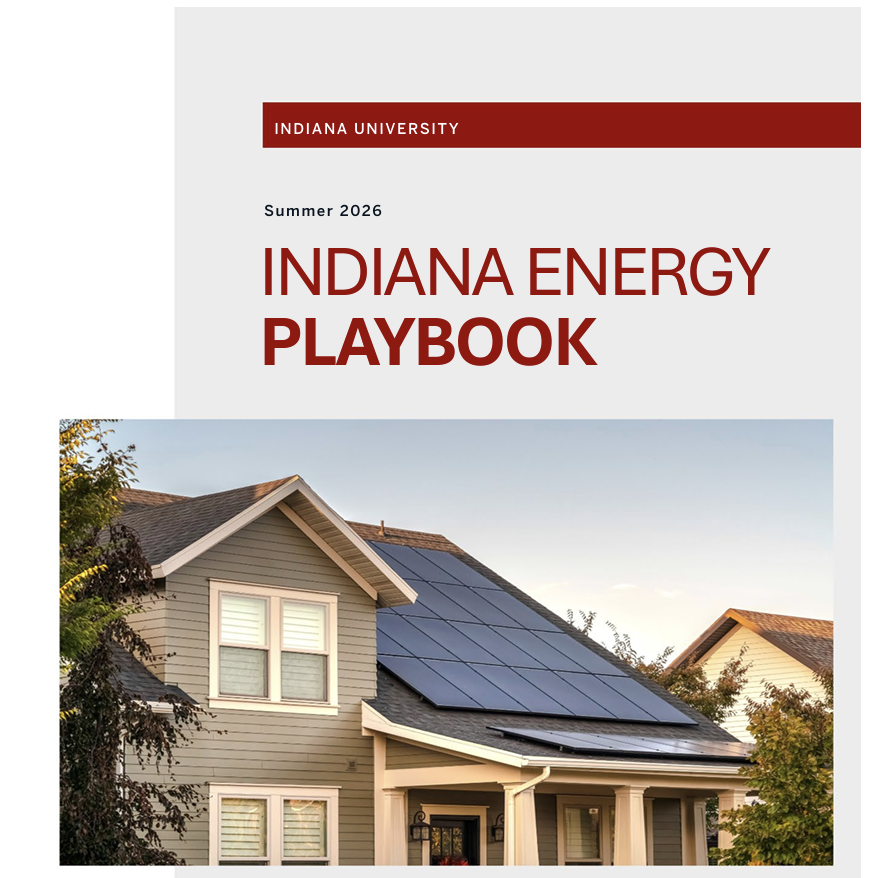
That disparity in resources is the gap the Indiana Energy Playbook closes. Created by researchers at Indiana University’s O’Neill School of Public and Environmental Affairs, the playbook turns complex ideas into a simple, step-by-step guide to help Indiana towns save money and taxpayer dollars. It does not demand that a city hire a sustainability director or immediately become an expert in energy policy or advanced building envelope standards. It simply asks local officials to follow a proven process—one that has been stress-tested against Indiana’s specific regulations and current fiscal realities.
How Does the Indiana Energy Playbook Prioritize Economic Efficiency for Municipalities?
Let us be clear: the Indiana Energy Playbook is fundamentally an instrument for achieving economic efficiency, while its resource management benefits are a beneficial consequence.
Here are several examples from our state:
North Vernon successfully cut energy costs at a public facility by 95%. They achieved this not through unproven technology, but by implementing solar panels, LED lighting and HVAC upgrades, subsequently utilizing smart financing to scale those improvements across 49 buildings. In Indianapolis, the City-County Building locked in a 46% reduction in energy costs, guaranteeing annual savings exceeding $776,000. Muncie Community Schools reclaimed approximately $1.5 million in savings, while St. Joseph County retrofitted 11 buildings to save roughly $1.34 million every single year.
These results are attainable to all cities. Treat energy costs like any other budget item: find the waste, fix the biggest problems first, and use solutions that pay for themselves.
The playbook makes this methodology replicable. It guides communities from initial energy audits and building prioritization through low-cost victories—such as LED retrofits and smart thermostats that routinely yield 50-70% lighting savings and 10-30% HVAC savings. It then scales up to comprehensive capital investments and solar feasibility, utilizing frameworks like Indiana’s Guaranteed Energy Savings Contract statute, which empowers municipalities to execute comprehensive upgrades with zero upfront cost, repaying the capital strictly through the generated savings.
What Are the Two Tracks in the Indiana Energy Playbook That Lead to Equitable Energy Efficiency?
Recognizing the complex interactions between local governments and their constituents, the playbook is structured around two parallel tracks.
The Municipal Energy Efficiency Track is the optimal starting point. It focuses on the infrastructure under direct municipal control: city halls, public works facilities, and police stations. Every dollar reclaimed from these utility bills reduces governmental waste redirecting it back into community services and operational budgets.
The Community Energy Efficiency Track looks outward. It helps residents, renters, landlords, and small business owners who are struggling with rising utility bills. It guides the implementation of weatherization programs, heat pump adoption and the need to ensure low-income households can access the efficiency upgrades that will benefit them the most.
How Can the Indiana Energy Playbook Help Communities Overcome Energy Efficiency Resource Disparities?
The Indiana Energy Playbook focuses on local data. It clearly explains Indiana laws, permit rules for battery storage and heat pumps and local zoning laws. Furthermore, it identifies accessible funding mechanisms, from the Indiana Energy Independence Fund and the Indiana Resilience Funding Hub to Duke Energy rebates and ENERGY STAR programs. Complete with a Partner Directory, a solar readiness checklist and a 90-day action plan, the fundamental research has been completed.
A few simple truths: Energy bills will not spontaneously decrease, state revenues are constrained, and our infrastructure continues to age.
Every year a town waits to fix its energy waste is a year of lost money and missed chances. The Indiana Energy Playbook is freely available and designed specifically for those striving to make an impact without specialized departments. It illuminates a definitive path forward if your community is ready to take action and get started.
What You Learned
- Understanding why the main obstacle for Indiana municipalities isn’t a lack of wanting, but a lack of a clear, actionable roadmap.
- Seeing how real-world examples in Indiana—from North Vernon to Indianapolis—have utilized efficiency upgrades to generate significant annual savings.
- Learning the difference between the Municipal Energy Efficiency Track (internal infrastructure) and the Community Energy Efficiency Track (public-facing initiatives).
- Accessing research-backed data on local Indiana Code, funding mechanisms, and proven tools designed to help communities implement changes without the need for specialized sustainability departments.